

Gems of Burma
Myanmar (formerly Burma, a name still much used by foreigners and the local population alike…) has a long and rich history of gemstone mining. Burma was once the world’s largest producer of rubies, and although production has declined in recent years, the country is still home to some of the finest rubies and sapphires in the world.
Myanmar (formerly Burma, a name still much used by foreigners and the local population alike…) has a long and rich history of gemstone mining. Burma was once the world’s largest producer of rubies, and although production has declined in recent years, the country is still home to some of the finest rubies and sapphires in the world.
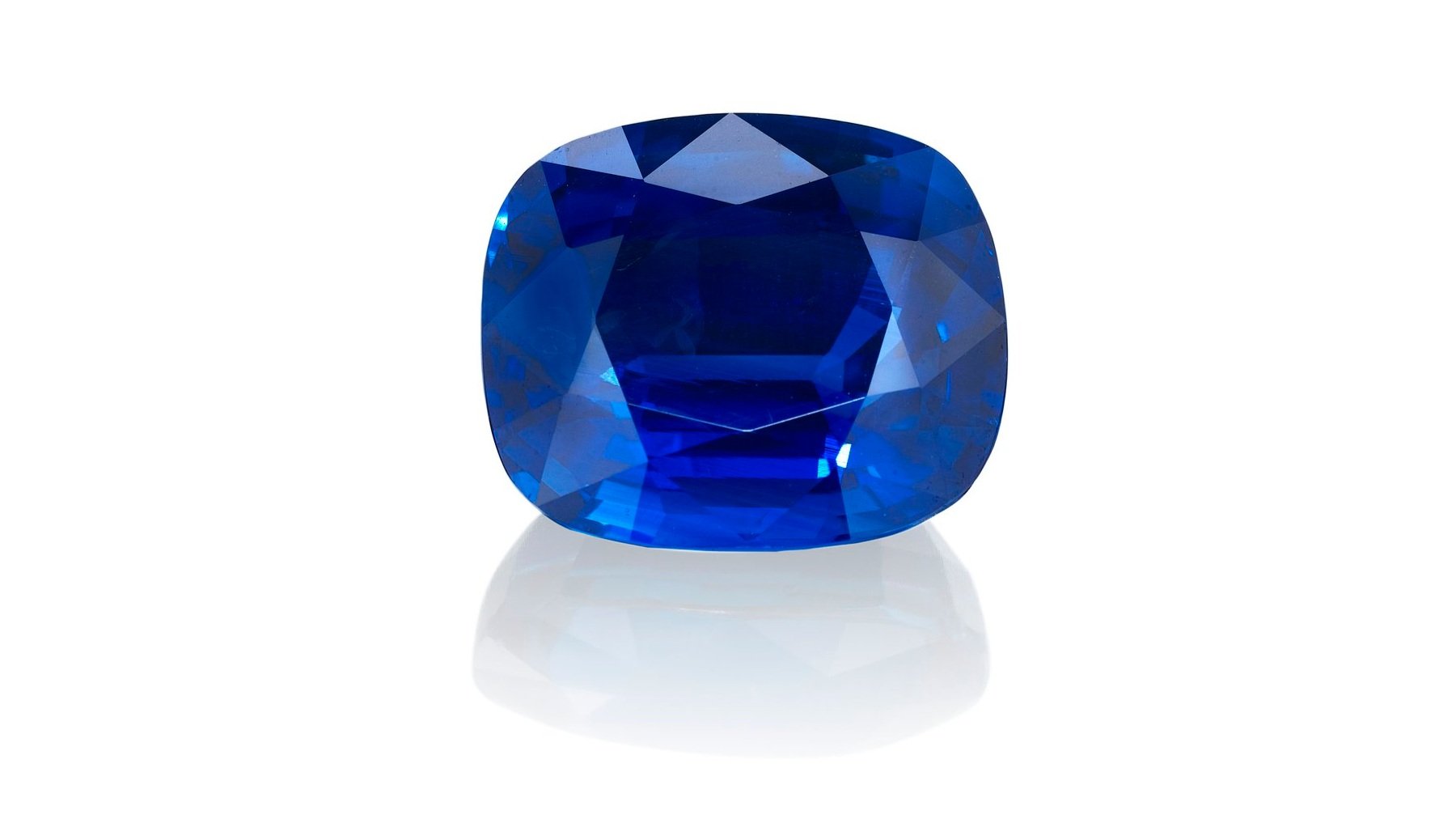
An exceptionally fine 11 ct Burma sapphire. Previously sold by Enhoerning. This is the blue sapphire color that has formed Burma’s reputation as the top source for naturally-colored (untreated) blue sapphire, right behind Kashmir.
History
Gemstone mining in what today is known as Burma/Myanmar is thought to have begun as early as the 7th century. The famed Mogok gem tract, a meandering network of mines in a mountainous area around the village of Mogok (assumed to be founded in 1217), has most probably been operating since the 16th century. During those times, Mogok became known as the “City of Rubies”. In the late 19th century, British colonialists began to heavily exploit Burma’s gemstone resources, and the country became the world’s largest producer of rubies and sapphires. Today, exports of gems are still believed to account for up to half of the country’s GDP, but total quantities of gems exported are much lower than in past centuries, also due to decreasing output of high quality gems from the mines.

Mogok ‘City’, in the Mandalay Region of central Myanmar, is believed to have been founded in 1217. The surrounding area has supplied the world with gemstones of the highest quality for centuries. Courtesy: JimmyWinMGK, Creative Commons.
What kind of gemstones are mined in Burma/Myanmar?
Remarkably, there are not many gems that do not naturally occur in Burma – although mostly known for rubies and sapphires, the gem pits especially of the Mogok region have produced an incredibly wealth of different gem species, including but not limited to garnets of various colors, various colors of beryl including aquamarine; peridot, chrysoberyl, many colors of quartz, tourmaline, moonstone, and spinel. Among the spinels, the deep-red to neon-pink varieties have risen to great fame in recent years. Burma is the world’s most important exporter of gem-grade jadeite, and it used to be an important producer of cultured South Sea pearls. The only classic gemstone that is almost never found in Burma is emerald – beryl that is colored to a deep green color by chromium or vanadium (lighter green beryls do occur). Despite the great diversity of gems mined in Myanmar, ruby and sapphire, perhaps along with jadeite, have always been the commercially most relevant products of the mining industry.
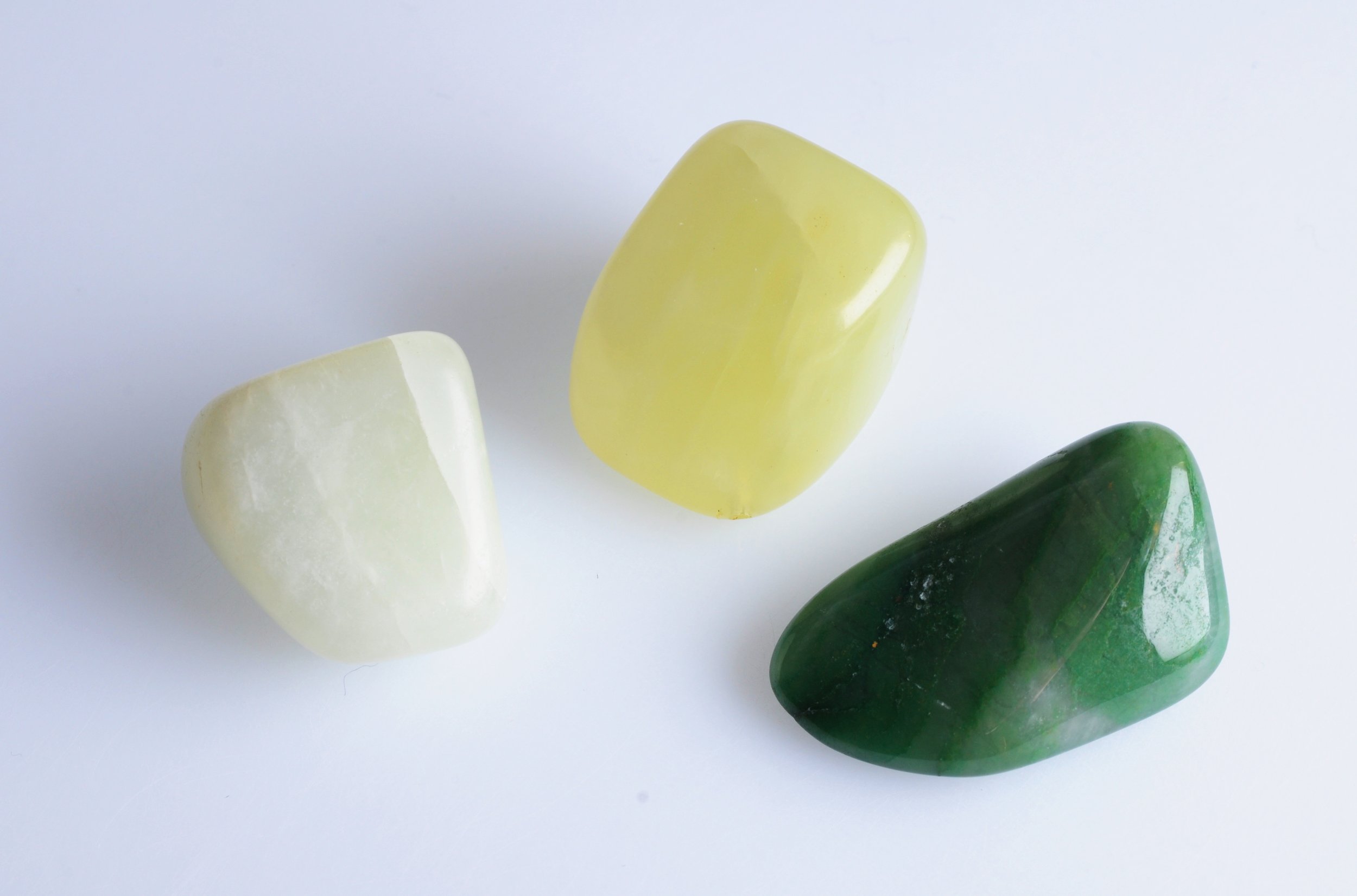
In Burma/Myanmar, gem quality jadeite is found in various colors. Courtesy: Simon A. Eugster, Creative Commons.
Why are rubies from Burma considered the finest in the world?
It is a misconception to assume that no ruby from any other origin can be as red, lively, vibrant and beautiful as one from Burma. Exceptionally fine rubies can be found in many countries, including but not limited to Afghanistan, Ceylon/Sri Lanka, Kenya, Madagascar, Malawi, Mozambique, Tajikistan, Tanzania, and Vietnam. Nevertheless, Burmese rubies have set a reference standard for the perfect ruby red, and most people, even without any prior knowledge of the jewelry trade, would identify a classic ‘pigeon’s blood red’ ruby from Burma (and especially from the Mogok mining region…) as the epitome of a fine, gem-grade ruby.

A very fine pair of pear shaped ‘pigeon’s blood’ rubies from Burma, unheated/untreated, previously sold by Enhoerning.
The distinctive appearance of Burmese rubies is mostly caused by two factors: first, they are primarily colored by the trace element chromium, while rubies from other regions (most African sources and those from Thailand) are colored by iron. Second, the presence of chromium in high concentrations, in the absence of high iron content, makes Burma rubies fluoresce in daylight or sunlight with an ultraviolet component. But how does that matter?
The thing about fluorescence
When chromium-rich rubies are exposed to ultraviolet light, such as contained in natural daylight or sunlight, they will typically respond with strong fluorescence of pink to red color.
An unheated/untreated Burma ruby, previously sold by Enhoerning, responding with strong pink fluorescence to longwave ultraviolet light.
This fluorescent effect, in addition to the red body color of the gemstone, can dramatically increase the perceived level of saturation (‘vividness’), while having a brightening effect, often romantically referred to as “glow”. This effect is highly desirable, and all rubies from Burma – be it from the old mines of Mogok or the more recently discovered ruby deposits of Mong Hsu – will show strong to very strong fluorescence.
That does not mean that rubies from other sources do not show fluorescence. Virtually all rubies do, to some degree. Strong fluorescence can, against all prejudice, even be found in some rubies from Mozambique. But if very strong fluorescence is desired, nothing outrivals a ruby from Burma/Myanmar.
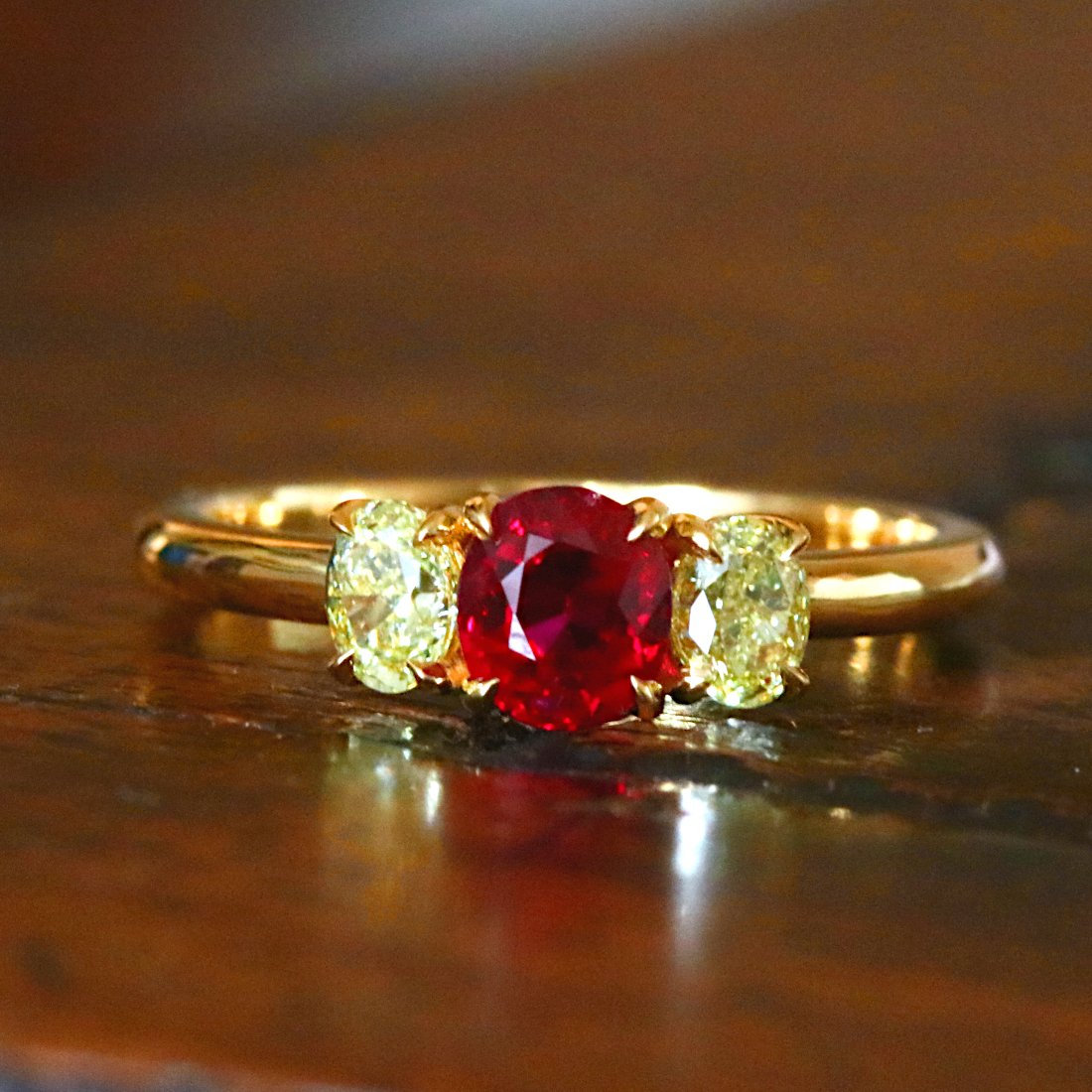
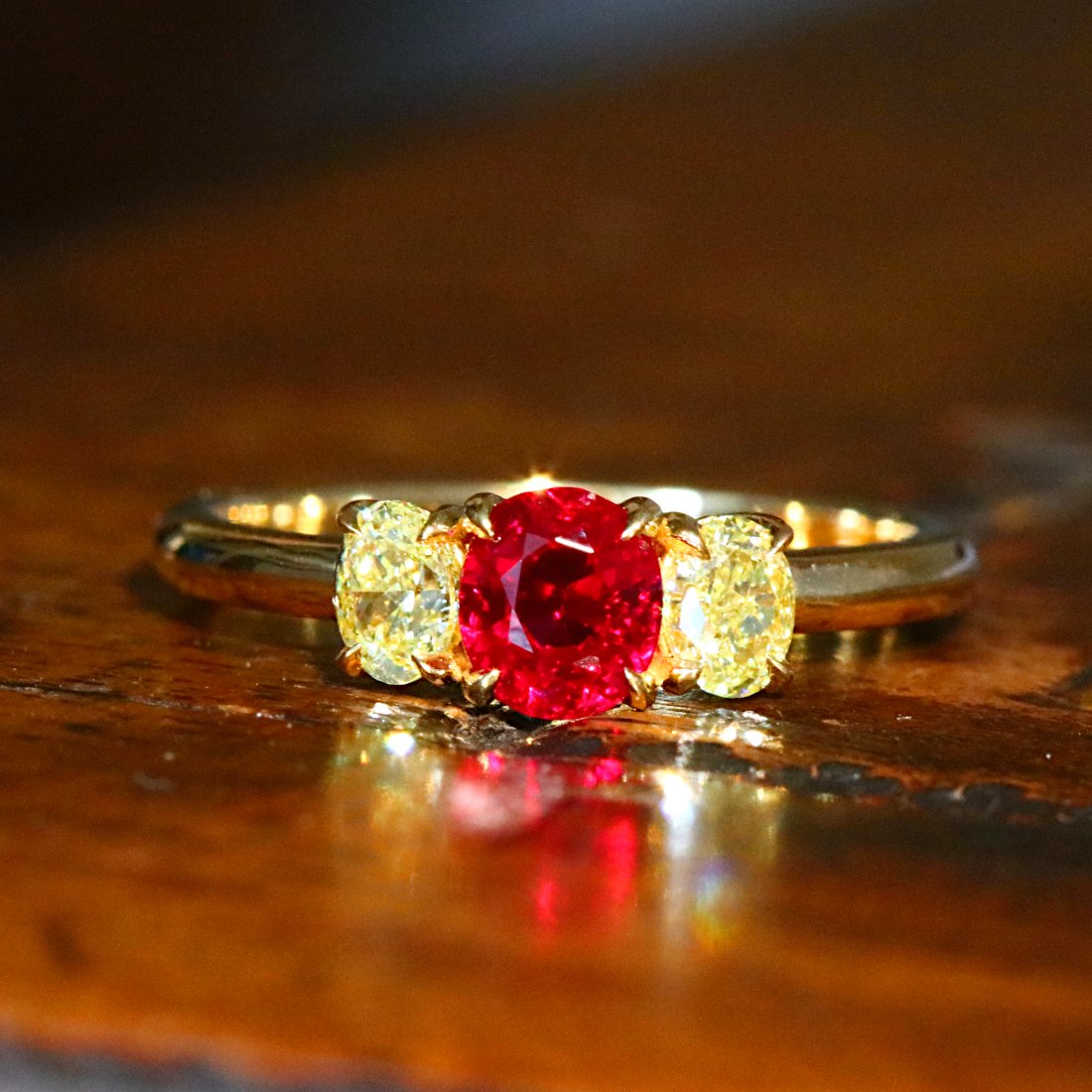
An unheated/untreated Burma ruby, previously sold by Enhoerning, showing the result of fluorescence when exposed to natural sunlight. Please note: in natural sunlight, you will usually not see the fluorescence itself (for that you have to use ultraviolet light in a darkened room). What is eye-visible is the famous ‘glow’ caused by the fluorescence.
What makes blue sapphires from Burma special?
At first glance, blue sapphires from Burma can resemble fine specimens from other sources, including but not limited to Ceylon/Sri Lanka, Kashmir, and Madagascar. Blue sapphires from all those sources have been formed in metamorphic host rock, so they share common characteristics from a geological point of view. What sets the Burmese ones apart is their overall quality! Most blue sapphire found in Ceylon/Sri Lanka has to be heat-treated in order to develop a strongly saturated, evenly distributed blue color. Blue sapphires from Burma usually have a fully developed, all-natural color right out of the mine. It is rare to even encounter a heat-treated Burma sapphire. This is the main reason why Enhoerning always stocks fine sapphires specifically from Burma. Some of our most successful ‘custom sourced’ gemstones have been of Burmese origin – these special stones simply make happy customers!

This very fine unheated/untreated Burma sapphire is currently available for purchase in the Enhoerning online shop.
Ethical considerations – are our Burmese gems ‘conflict free’?
With a checkered recent history of military coups, dictatorship, struggle for democracy, civil war, reports of serious human rights violations, and on/off sanctions imposed by Western governments, trading gemstones originating in Burma/Myanmar is not entirely unproblematic. Other than in the 1990s to early 2000s, when American sanctions de-facto prohibited any import of Burmese gems into the United States, current sanctions, in place since March 2021, are strictly targeted at the military leaders ruling the country. This means that gemstones from Burma/Myanmar can still be imported into the United States, as long as the buyer/importer can effectively prove that no sanctioned entities or individuals are benefiting from the transaction anywhere along the supply chain. At first glance this may sound reasonable, but in practical terms and for the foreign buyer, it is nearly impossible! As a consequence, Enhoerning Jewelry only deals in gemstones from Burma/Myanmar that were exported prior to February 2021 at the very latest (the date of the most recent military coup overthrowing the democratically elected civilian government). All our Burmese gems are vintage or antique stones that are either offered in their original vintage/antique mountings, or that have been reclaimed from old jewelry pieces and recut/repolished prior to being offered for sale by us. On the positive side it should be noted that most antique gemstones from Burma greatly exceed the newly mined material in quality. Purchasing antique or ‘reclaimed’ gemstones of Burmese origin is not only a safe choice with regard to ethical considerations, but it will – more often than not – allow you to acquire the finer quality gem.

Antique gems and jewels are considered the best choice for an ecologically sustainable and ethically worry-free purchase. This Edwardian era ring, featuring an unheated/untreated Burma ruby, is currently available for purchase in the Enhoerning online shop.
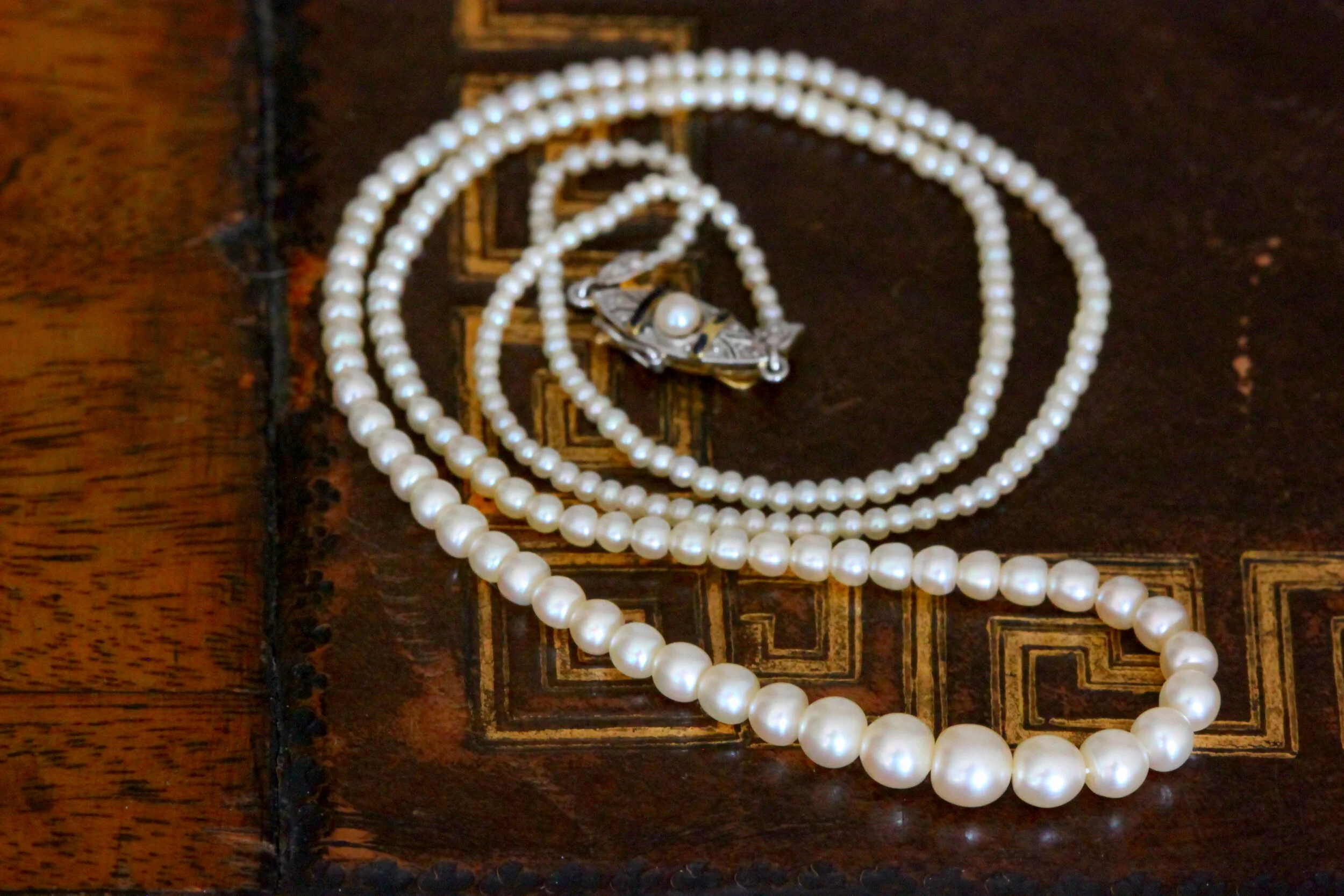
Natural Pearls – The Original Made by Mother Nature
A cultured pearl is a manmade sphere covered in a thin layer of pearl nacre. In a natural pearl, however, there is no nucleus inside the pearl – the pearl is solid through and through, consisting of countless layers of nacre developed around the original foreign particle (usually tiny!) that prompted the oyster to create a pearl. A natural pearl is made without any human help or intervention. It is a marvel made by mother nature.
More than 120 years after the invention of the process to produce cultured pearls, there is again a very strong demand for natural pearls in the world of fine jewelry enthusiasts. So what are natural pearls, and what makes them so rare, special and exciting for the contemporary jewelry collector?
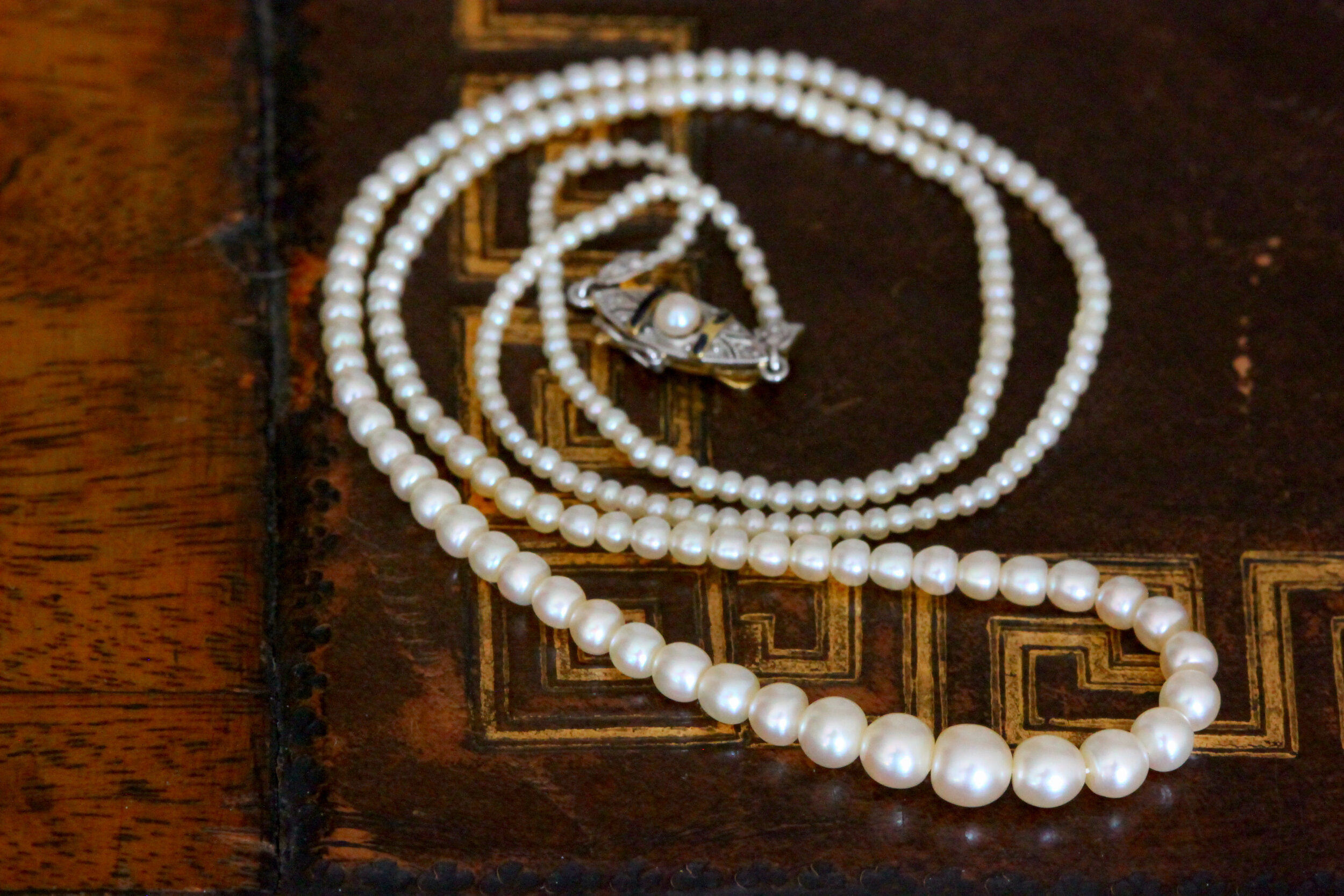
A small but very fine strand of natural pearls, Swedish, made around 1900-1910.
What are pearls?
Pearls, whether natural or cultured, are organic gems usually created by an aquatic mollusk (clams, oysters, scallops, you name it…) in either freshwater or saltwater. A pearl is created when a foreign object (like a grain of sand, sometimes a parasite) gets inside a mollusk and irritates the soft tissue that lines its shell. The mollusk tries to reduce the potential harm of the forgeign object by coating it with layers of smooth nacre, a crystallized form of calcium carbonate. After layers and layers of nacre coating, a process that can continue for months if not years, the foreign object – an irritant perceived by the oyster as a threat – will be transformed into a beautiful pearl. Traditionally, the most treasured pearls, both natural and cultured, are created in a marine (saltwater) environment by oysters of the genus Pinctada. Freshwater pearls can be fine organic gems as well, but they usually cannot compete with the luster of the finest natural saltwater pearls.
What are natural pearls?
In nature, pearls are created solely ‘by accident, only under conditions as described above. This happens very, very rarely, and for this reason, pearls have been considered extremely rare and valuable in past centuries. Around the year 1900, fine-grade natural pearls were valued at a higher cost per carat than fine colorless diamonds, an extremely rare commodity as well, at that time.
“A cultured pearl is a manmade sphere covered in a thin layer of pearl nacre. In a natural pearl, however, there is no nucleus inside the pearl – the pearl is solid through and through.”
What are cultured pearls?
In order to fully appreciate what natural pearls are, we first need to understand what a cultured pearl is. Since the creation of a natural pearl happens very rarely in nature, humankind found a way to recreate this process in a way that allows pearl farmers to produce cultured pearls in almost unlimited quantities. For this, a so called bead nucleus – a manmade spherical structure – and a mantle-tissue piece are implanted into an oyster, provoking the oyster to coat the artificial core in nacre, hence forming a ‘pearl’ around the manmade basic structure. This process was invented by Mikimoto in 1893, and commercialized in the first decades of the 20th century. From around 1920 onwards, practically every pearl in the market was a cultured pearl produced using the Mikimoto process, making pearls, previously considered more valuable than diamonds, affordable to a much wider group of buyers.
So what exactly is the difference again?
At the end of the day, and stripped of all romance, a cultured pearl is a manmade sphere covered in a thin layer of pearl nacre. In a natural pearl, however, there is no nucleus inside the pearl – the pearl is solid through and through, consisting of countless layers of nacre developed around the original foreign particle (usually tiny!) that prompted the oyster to create a pearl. A natural pearl is made without any human help or intervention. It is a marvel made by mother nature.

The main difference between cultured and natural pearls. Credit: Creative Commons.
Why are natural pearls rare?
Without any human intervention, a gem quality pearl is created in about 1 out of 10,000 Pinctada oysters. And that one oyster containing a pearl is not readily accessible in a pearl oyster farm, but it is out in the open ocean and needs to be found by a highly skilled (and patient!) pearl diver. Hence, in order to create a natural pearl necklace consisting of at least 100 pearls, you need to find and open about one million oysters! In past centuries, pearl diving was a thriving industry in the Persian Gulf region, the predominant source of fine, natural saltwater pearls. Today it practically is a lost art. As a result, most natural pearls in the market nowadays are antique. There is one famous anecdote, most of which is true, that is an impressive testament to the rarity and desirability of true natural pearls: In 1916 (some say 1917), Pierre Cartier, acquired the iconic headquarters of the maison on 5th Avenue New York by trading an exceptional double strand of natural pearls against the by now absolutely priceless landmark building. Much less expensive, but not much less impressive, is our very own natural pearl necklace by Cartier.
“In order to create a natural pearl necklace consisting of at least 100 pearls, you need to find and open about one million oysters!”
Do natural pearls look and feel different from cultured pearls?
Yes! The first thing you will notice when comparing natural and cultured pearls is the weight. Natural pearls, consisting almost entirely of thick pearl nacre, will feel surprisingly heavy and solid in your hand, especially when compared side by side with much more lightweight cultured pearls. With most natural pearls you will also notice differences in shape and size, compared to cultured pearls. Due to their extreme rarity, natural pearls are considered fine grade even when they are much less perfect (less round, perhaps slightly blemished) than what you would expect from cultured pearls. Cultured pearls can be perfectly round because they are formed around a manmade, perfectly spherical bead. In the absence of such a bead, natural pearls can be a little bit more idiosyncratic in shape – more oval, or simply ‘roundish’ instead of perfectly round, and sometimes even pear shaped or ‘baroque’. While off-round shapes are considered unacceptable in cultured pearls, natural pearls are graded more generously, considering the overall beauty of a strand rather than the degree of perfection in every individual pearl.
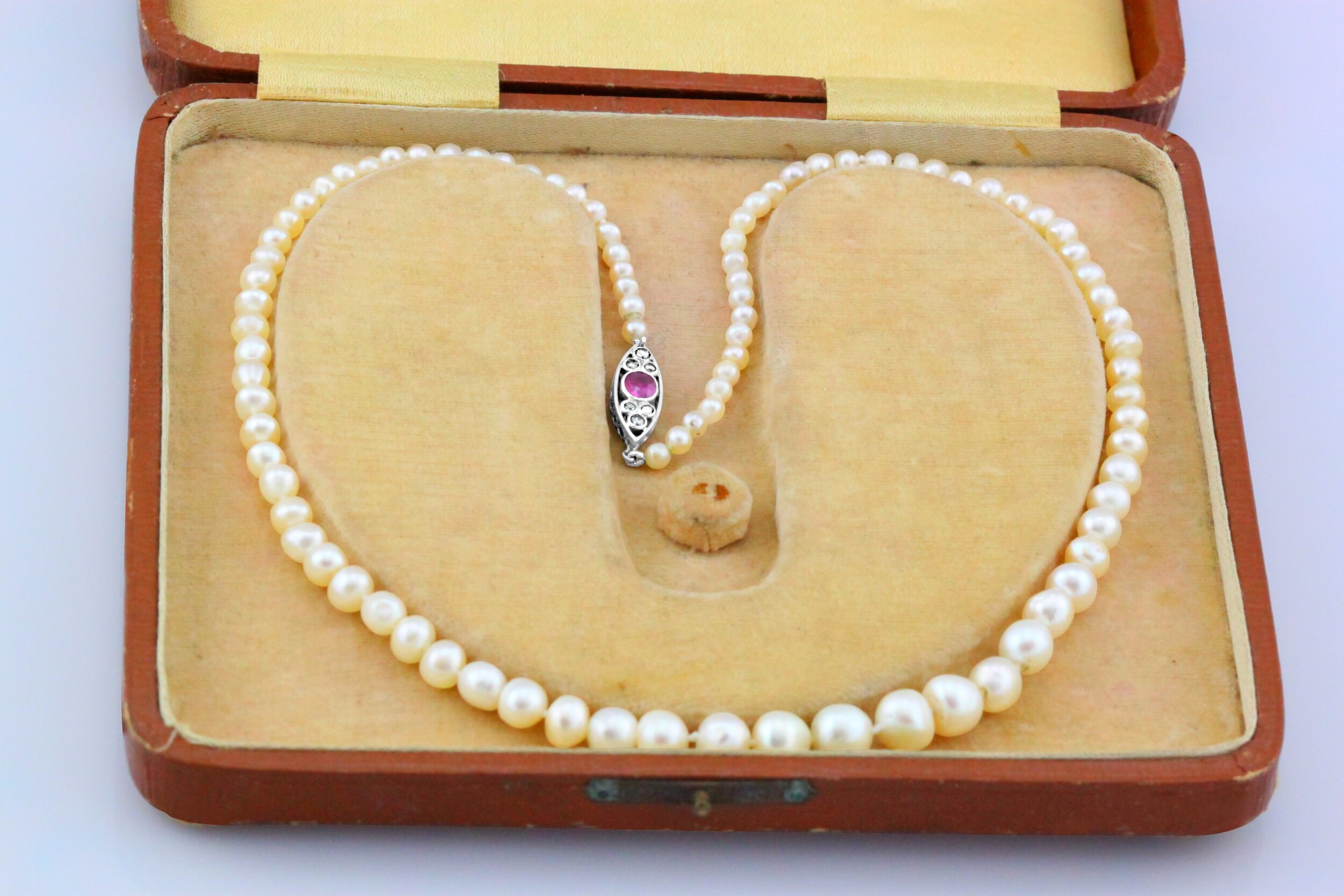
A fine strand of natural pearls, topped with a Burma ruby clasp, previously sold by Enhoerning Jewelry.
How do I know a strand of pearls is truly natural = not cultured?
While some natural pearls can be identified as non-cultured very easily (often by inspecting the nacre thickness through the holes drilled for stringing…), there are countless ways of ‘faking’ the look and feel of a natural pearl. Therefore the only way to be sure that a strand of pearls is truly natural is to rely on a reputable laboratory report. In the United States, the first choice for a natural pearl report is the Gemological Institute of America (GIA), and there are several other labs around the world that are reliable partners in the identification of natural pearls. Never attempt to purchase a strand of natural pearls without a lab report confirming the natural origin of the material, and the absence of treatments to alter the appearance of the pearls. Even within the jewelry trade, no strand of natural pearls changes hands without a valid lab report.
How can I purchase a strand of true natural pearls?
Most of the natural pearls in the market today are old material, i.e. vintage or antique. Hence your best chance of acquiring a strand of these rare treasures is from an upscale jeweler carrying fine estate pieces. In any case, keep in mind that any legitimate offer of true natural pearls will come with a GIA (or similar) report that is explicitly confirming both the “natural” origin of the pearls and the absence of treatment. We at Enhoerning Jewelry are proud to always keep at least one strand of fine natural pearls in stock. You can browse our current selection of natural pearl necklaces here.

Kashmir Sapphire – FAQ
It’s all about the color! The typical Kashmir blue is a highly saturated (vivid) blue with a minute tinge of purple. But it is also about the “texture”. Kashmir sapphires, more often than sapphires from other locations, exhibit microscopic silk inclusions and growth zoning patterns which, if evenly distributed throughout the stone, give the sapphire a velvety appearance, in the gem trade often referred to as a “sleepy” character. Sleepy sapphires tend to “glow” when hit by both natural or incandescent light, because the light is reflected back from the hundreds and thousands of microscopic inclusions inside the sapphire. Blue sapphires with a sleepy appearance tend to hold their color very well and appear vibrant and powerful, even in low light, which sets them apart from sapphires without these microscopic inclusions.
Q: What makes a Kashmir sapphire so special?
A: It’s all about the color! The typical Kashmir blue is a highly saturated (vivid) blue with a minute tinge of purple. But it is also about the “texture”. Kashmir sapphires, more often than sapphires from other locations, exhibit microscopic silk inclusions and growth zoning patterns which, if evenly distributed throughout the stone, give the sapphire a velvety appearance, in the gem trade often referred to as a “sleepy” character. Sleepy sapphires tend to “glow” when hit by both natural or incandescent light, because the light is reflected back from the hundreds and thousands of microscopic inclusions inside the sapphire. Blue sapphires with a sleepy appearance tend to hold their color very well and appear vibrant and powerful, even in low light, which sets them apart from sapphires without these microscopic inclusions.
Q: But aren’t inclusions flaws that you would usually want to avoid in a gemstone?
A: Yes and no. While single eye visible inclusions are generally not desirable in any gemstone, microscopic silk inclusions can add to the beauty of a gem. And a Kashmir sapphire – famous for this special inclusion type and the radiant blue – would not be as desirable without them. A Kashmir sapphire with a perfectly clean crystal would generally not be considered as valuable as its “sleepy” counterpart. On the other hand, the “sleepiness” should never be so strong that it significantly affects the overall transparency of the gemstone.

Q: Are Kashmir sapphires the only “sleepy” blue sapphires?
A: No. Sleepy or velvety blue sapphires have always been found in other mining regions as well, notably in Ceylon/Sri Lanka, Burma/Myanmar, and more recently in Madagascar. It is possible to find a “Kashmir-like” blue sapphire from one of these countries of origin, and it will be only a fraction of the price of a real Kashmir sapphire.
Q: Why are Kashmir sapphires so expensive?
A: Buying a Kashmir sapphire means not only to buy the finest quality blue gem. It also means buying – and becoming part of – a legend. Kashmir sapphires have been found in only very limited quantities in two small mines high up in the Himalayas. The sapphire deposit up there, at an altitude of 14,700 ft (4500 m), was discovered in 1880. Only 7 years later, in 1887, most of the fine quality material had been mined out. By 1930, the production of gem quality sapphire in the Kashmir mines had ceased. This means: all Kashmir sapphire in the market today is antique material. There has not been any new production for almost a hundred years, and in all likelihood – many attempts have been made – there will not be any new, fine quality finds from the region. In a nutshell: the Kashmir sapphire is an extinct species, and this is reflected in the way it is traded and priced.

Q: Do I need a Kashmir sapphire?
A: Probably not, but you will enjoy having one. It is an excellent choice if your budget allows it, and you want to buy a gemstone with investment potential. As mentioned above, owning a Kashmir sapphire means becoming part of the legend, and acquiring a heirloom piece with a rich history of its own. However, if you are simply looking for a fine quality blue sapphire, you will have many more options to choose from when considering sapphires from other regions of origin as well.
Q: Are all Kashmir sapphires top quality?
A: No, absolutely not. While the average Kashmir sapphire from the original finds is of remarkable quality and superior to most other sapphire material, exceptions do apply. Especially sapphires mined more recently from the – officially closed – mining area can be poor quality. Hence it is not advisable to buy a sapphire solely based on a lab report confirming the origin from Kashmir. Always look for beauty first, and only then consider the origin and paperwork.

Q: Talking of lab reports – how can I be sure my Kashmir sapphire is really from Kashmir?
A: Reliably identifying Kashmir origin in a sapphire is a tricky business. The difficulty lies in the fact that both physical and chemical properties of Kashmir sapphire strongly resemble and partially overlap with the properties typical of blue sapphire from both Madagascar and Ceylon/Sri Lanka. Only a lab with an extensive reference collection of Kashmir specimens, and advanced technology (FTIR and LA-ICP-MS) is able to accurately identify Kashmir sapphire. Within the gem trading industry, the origin reports of these three laboratories are generally considered valid when it comes to Kashmir sapphire: AGL (New York, USA), Gübelin (Lucerne, Switzerland), SSEF (Basel, Switzerland).
Color stability in fancy sapphire – what is this all about?
Even though color stability of fancy color sapphire has been discussed for decades, the issue has become more widely known only very recently, with more and more labs adopting rigorous color stability testing procedures, mostly as a result of the recently increasing popularity of padparadscha sapphire. Having received several emails from concerned clients within only a couple of days, we thought we should share some information.
Even though color stability of fancy color sapphire has been discussed for decades, the issue has become more widely known only very recently, with more and more labs adopting rigorous color stability testing procedures, mostly as a result of the recently increasing popularity of padparadscha sapphire. Having received several emails from concerned clients within only a couple of days, we thought we should share some information.

This 5 ct unheated padparadscha has been positively tested for color stability by Lotus Gemology, Bangkok.
The following is in no way meant as a scientific treatise on the issue of color stability (please refer to the big labs for academic writing on this…), but more as a practical FAQ for gem enthusiasts.
What is “unstable color” in sapphire?
Scientists rather speak of a gem having a “color center” that has two different states, a “relaxed” (inactive) and an “active” one. As an example, imagine a peach sapphire, with a basic orange color and a color center containing pink. If that color center is active, it will give the sapphire its overall peachy, if not even padparadscha-like color. If the color center is relaxed (inactive), the sapphire will only appear orange (but not peach-colored anymore).

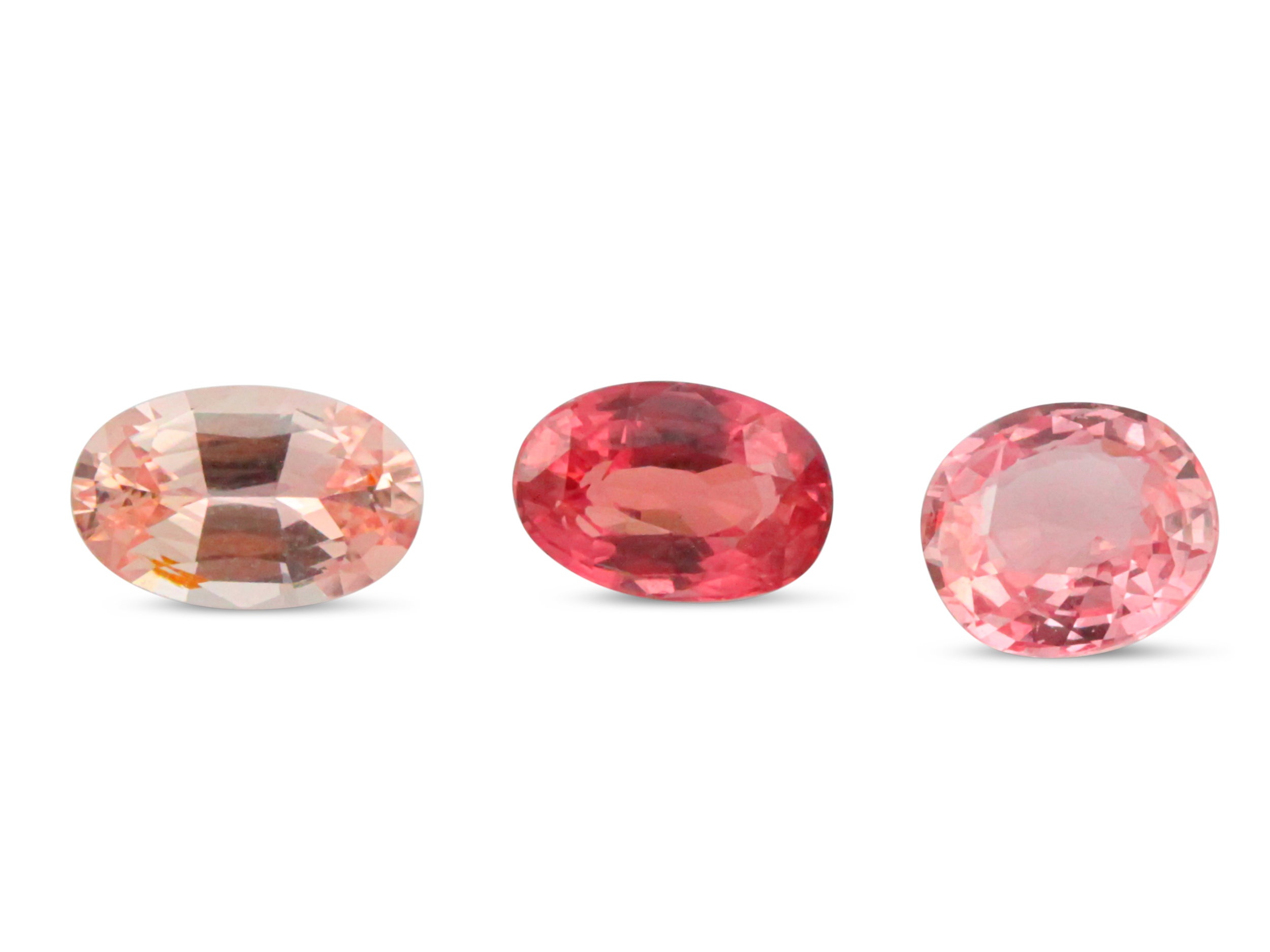
These three unheated padparadscha sapphires have been positively tested for color stability by AGL (New York) and Gübelin (Lucerne, Switzerland).
What makes the color center become active or relaxed/inactive?
Color centers can become active or relaxed as a consequence of exposure (or the lack of exposure) to certain light sources and possibly heat. UV radiation plays an important role in this, with color centers commonly switching to their inactive/relaxed states when the gem is not exposed to UV radiation over an extended period of time. This can be the case, for instance, when a gem is stored in a safe for several months or even years. The phenomenon of “fading” (a color center becoming inactive) under such circumstances is well known for yellow sapphire, and similar effects have recently been observed in padparadscha – and other fancy color – sapphire.
Is this effect reversible?
Yes. The good news about this color stability issue is that an inactive/relaxed color center can always be activated again by exposure to, for instance, natural daylight. If a color center in a sapphire, for instance after years in a bank safe, has turned to its relaxed state, this does not mean that the stone is “ruined”. Under the right circumstances the color center can become active again.
Does this have anything to do with the gem being treated?
No. Unstable color centers have been detected in both heat treated and unheated/untreated sapphires. However, with heated (let alone beryllium-heated) padparadscha sapphires generally not being considered “the real deal” anyways, the issue is more relevant for unheated gems.
How about origin?
Unstable color centers can occur in sapphires from all geographic origins. However, our experience with numerous padparadscha sapphires has shown that those from Sri Lanka tend to have stable color (i.e. they almost without exception pass the color stability test, for instance applied by AGL). When we recently encountered a padparadscha that had failed the color stability test, it was in most cases from Madagascar. This is purely an observation, it does not mean that Madagascar is the only origin that produces sapphire with non-stable color. And of course it does not mean that all padparadscha sapphires from Madagascar have an unstable color center (some are perfectly stable, and this can be proven with a color stability test).

This padparadscha sapphire is from Madagascar, but has been positively tested for color stability by AGL (New York).
Are all colors of sapphire affected?
No. Affected are sapphires in the color range of near-colorless, yellow, pink, lavender, orange, and padparadscha (orange-pink or pink-orange). As it seems, blue sapphires are never affected.

This near-colorless sapphire was diagnosed by AGL (New York) with a rare phenomenon. When the color center is active, it appears pale yellow-orange. When the color center is relaxed, it is near colorless with a slight bluish tinge. A collector was thrilled to acquire this rare gem from us, so an unstable color center is not always a bad thing.

The AGL report for the colorless to yellow-orange sapphire mentioned above. Note the comments that AGL made about this stone.
If the color of my sapphire is not stable, what does this mean for value?
If your sapphire tests to have an unstable color center, there is no reason to be overly concerned if it is, for instance, a yellow sapphire. The phenomenon has been known for a long time to occur in yellow sapphire, and due to its reversible nature, it has little effect on value.
This is different when it comes to padparadscha sapphire. So why is that? Actually, several labs, including AGL and Gübelin, have stopped granting the “padparadscha” color designation if the required combination of pink and orange is not visible in both the active and the inactive state of the color center. This means: a sapphire that looks like a padparadscha with the color center active, but not anymore with the color center inactive/relaxed (or vice versa), is NOT CONSIDERED A PAD ANYMORE by most major labs. As a consequence, countless sapphires that would have been considered a padparadscha less than a decade ago, will not be called padparadscha anymore by the major labs. The consequences for the value of an affected gemstone are dramatic.
Does this mean a sapphire with an unstable color center can never be a padparadscha?
No. If a sapphire shows an unstable color center, but both states (color center active/relaxed) show a padparadscha-like combination of orange and pink, the major labs – such as AGL and Gübelin – will still consider it a padparadscha. Why? Because the desirable color is always there, it only shifts around a little. In some cases, an orange-pink sapphire can shift to pink-orange, and both combinations are unquestionable pad colors, so no issue there.

AGL report for our 1.05 ct Madagascar padparadscha. Please note AGL’s comment “stable color identified” – when shopping for padparadscha, make sure this is what you get (and pay only very little for a non-stable pad-like sapphire).
How can I be on the safe side when buying sapphire?
If you want to be sure that the color of your sapphire is stable – which is relevant mostly when buying padparadscha – buy only with a recent lab report that is stating both that a color stability test has been performed, and that a stable color has been identified. AGL, among other labs, is offering reports like that.